
Working in a hospital, I find it fascinating how the use of big data is reshaping the healthcare industry. The topic is personally very important for me as I want to discover more about how the availability of massive data can help save and improve lives. Through healthcare analytics, it is possible :
- To forecast outbreaks of epidemics.
- Reduce the cost of medical treatments.
- Prevent some diseases.
- Improve the quality of life of people in general.
Every second, huge amount of data is being generated and captured all over the world. These data come in several forms (structured, semi-structured and unstructured) and “big data deployments often involve terabytes (TB), petabytes (PB) and even exabytes (EB) of data captured over time” (Rouse, s.d.). Collecting and analyzing data gives a competitive advantage to any business and the healthcare industry is no exception.
Big data is one of the megatrends of modern Information Systems. Healthcare professionals, just like entrepreneurs and business persons, can collect massive data and develop strategies accordingly to take advantage of the access to data.
- Cost Reduction and Improved Efficiency
One way that big data is advancing the healthcare industry is by reducing costs and improving efficiency of medical institutions. As stated out by Forbes, hospitals in Paris is making use of data analytics and machine learning to predict the admission rates of patients. At 4 of the hospitals of Assistance Publique-Hôpitaux de Paris (AP-HP), data have been collected internally and externally, as well as, the admission records of the past 10 years have been inserted in algorithms (Marr, 2016). These hospitals can predict the daily and hourly number of people who will cross the doors. The core part of the analytics uses time series techniques that find patterns that are used to predict admissions. As such, there is better deployment of medical staff. During peak time, managers plan to have more doctors and other staff to cater for the high number of incoming patients. As such, there is no surplus of medical staff and patients’ queuing time is less. Adopted at national level, that will bring a decrease in healthcare services. This is a technology that are being considered by several countries such as the US and France, where the healthcare is funded through tax. New, smart and cutting-edge techniques that decrease healthcare cost is much needed to bring down the rising cost experiencing developed nations today.
- Telemedicine
More and more healthcare professionals are adopting telemedicine ; delivery remote medical services using technology. This is becoming more common with the growing use of smart devices, online video conferencing , wireless devices and wearables. Through the use of medical intelligence, healthcare professionals can develop predictive analytics. Database from medical records in clinics and hospital can help predict anomalies and allow doctors to provide care to patients as prevention is always better than cure. Doctors via telemedicine can carry first consultations and primary diagnosis and remote monitoring. This allow personalized treatment that reduces visits to hospitals, hospitalization or re-admission. Patients do not have to wait unnecessary hours and doctors can take only important consultations and also reduce paperwork. In UK, in 2018, 40,000 embrace the concept of Digital Health Interface by signing up for online consultations through an application (Adams, 2018).

Telesurgery is also gaining grounds with the availability of big data. Today, with the advent of 5G networks, surgeons can make use of real-time data to carry operations without having to be physically present with the patient. This is supported also by the use of robots.
- Electronic Health Records (EHRs)
Availability of voluminous data has improved significantly electric health records. Health bodies can now collect, store, manage and share data more effectively about patients. As stated by a study carried by Fadoua Khennou, from Higher School of Technology, in 2018, adopting EHRs reduces waste, diminishes administrative works, ensures availability of data, leads to cost reduction, improves the delivery of treatment and has improved in general the quality of healthcare services.
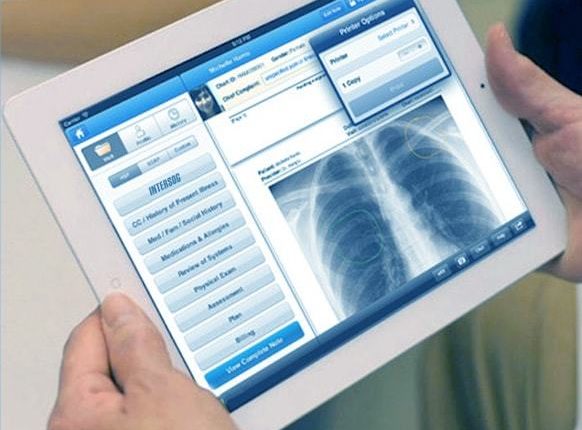
EHRs contain patients’ information such as demographics, treatments, allergies, past medical records and results amongst others. When these records are shared ,via secured networks, between both public and private institutions, they provide great efficiency in consultations and care delivery. As stated by an article in Kaiser Health News, adopting smart HER might have prevent cases such as that of a woman who was suffering from mental illness and substance abuse. In only 3 years, the 57-years old woman visited local emergency units more than 900 times (Gold, 2016). This would have been avoided if the different clinics and hospitals she went to, shared data about the patient’s medical history.
Big Data, with its volume, velocity and variety is improving the healthcare industry drastically as never before.
Transforming healthcare and medical education through clinical big data analytics.
Other uses of big data in medical fields are :
- Big data with Medical Imaging
- Deterring fraud and improving security
- Big data for Informed Strategic Planning
- Preventing Opiods abuse
- Real-time alerting

As any technology, Big Data brings its part of drawbacks that can also cause much damage to the healthcare industry. Next week, a new article about the cons of using big data in medical practices will be uploaded on the blog.
References :
Adams, T. (2018, July 29). The robot will see you now: could computers take over medicine entirely? Retrieved from The Guardian: https://www.theguardian.com/technology/2018/jul/29/the-robot-will-see-you-now-could-computers-take-over-medicine-entirely
Gold, J. (2016, June 22). In Alameda County, A Big Data Effort To Prevent Frequent ER Visits. Retrieved from Kaiser Health News: https://khn.org/news/in-alameda-county-a-big-data-effort-to-prevent-frequent-er-visits/
Khennou, F., Youness, I., & Chaoui, N. E. (2018). Improving the Use of Big Data Analytics within Electronic Health Records: A Case Study based OpenEHR. The First International Conference On Intelligent Computing in Data Sciences, 60.
Marr, B. (2016, December 16). Big Data In Healthcare: Paris Hospitals Predict Admission Rates Using Machine Learning. Retrieved from Forbes: https://www.forbes.com/sites/bernardmarr/2016/12/13/big-data-in-healthcare-paris-hospitals-predict-admission-rates-using-machine-learning/#34051e7479a2
Rouse, M. (n.d.). AWS analytics tools to help make sense of big data. Retrieved from searchdatamanagemnt.techtarget.com: https://searchdatamanagement.techtarget.com/definition/big-data
 Olivier's BLOG